
By alphacardprocess March 12, 2026
Accepting payments in the firearms and weapons retail space is not as simple as plugging in a card reader and opening a checkout page.
These businesses often face stricter underwriting, more payment scrutiny, and greater account stability concerns than many other retail categories. That makes Secure Firearms Payment Processing more than a convenience. It is a core part of staying operational, protecting revenue, and building customer trust.
For many retailers, the biggest frustration is not just getting approved. It is staying approved, keeping transactions flowing, reducing fraud, and avoiding disruptions that can hurt sales and reputation.
A payment setup that works for a typical retail store may not work well for a firearms dealer, online weapons retailer, or specialty seller with high-ticket items and elevated compliance expectations.
That is why secure, stable, and industry-aware payment acceptance matters. The right solution should help you process payments confidently in-store, online, over the phone, and for special-order transactions.
It should also help you manage chargebacks, monitor risk, protect cardholder data, and reduce the chances of surprise account holds or freezes.
This guide explains how Payment Processing for Gun Stores and Payment Processing for Weapons Retailers works in practice. It breaks down the tools, risks, best practices, and decision points that matter most.
Whether you are launching a new retail operation or improving an existing setup, this article will help you understand what secure payment acceptance looks like and how to build it the right way.
What Secure Firearms Payment Processing Really Means

Secure Firearms Payment Processing means using payment systems, controls, and providers that are equipped to support firearms-related transactions while protecting the business, the customer, and the payment data involved.
It is not just about accepting cards. It is about accepting them in a way that reduces risk, maintains compliance, and supports long-term account stability.
At a practical level, secure processing combines several layers. It includes the right merchant account, a compatible payment gateway, reliable point-of-sale tools, encrypted transaction handling, fraud screening, strong checkout practices, and clear operating policies. If even one layer is weak, the whole setup becomes more vulnerable.
Firearms and weapons retailers often deal with challenges that standard retail businesses may not face as often. Transactions can be higher in value. Online orders may attract more scrutiny.
Card-not-present risk can increase fraud exposure. Some providers may approve an account initially and then later decide the business does not fit their risk model. That is where secure infrastructure becomes essential.
A secure setup also supports everyday operations. It helps staff process sales correctly, makes online checkout smoother, reduces failed transactions, and gives owners better visibility into transaction trends.
It also improves the customer experience because buyers are more likely to complete a purchase when checkout feels professional, stable, and trustworthy.
Why “secure” means more than just data protection
When many retailers think about payment security, they think only about encryption or protecting card numbers. Those are important, but in this industry, security also includes business continuity.
A payment setup is not truly secure if your provider can shut down your processing after a policy review, or if weak fraud tools expose you to avoidable losses.
Security in this context has several dimensions. First, there is data security, which includes encryption, tokenization, SSL protection, and PCI compliance.
Second, there is transaction security, which includes AVS, CVV checks, fraud filters, transaction monitoring, and secure checkout controls. Third, there is account security, which means having a processor and merchant account structure that is appropriate for the business model.
A retailer may have a sleek online store and still be vulnerable if the merchant account is not designed for firearms-related sales.
Another retailer may have approval from a processor, but lack clear website disclosures, leaving the business exposed to chargebacks and underwriting issues. Secure processing works only when the technology and the account structure align.
This is why Firearms Merchant Payment Solutions tend to emphasize fit, not just features. The right solution must match the risk profile, order flow, average ticket size, sales channels, and product mix of the business. Otherwise, even a technically secure system can become operationally unstable.
The difference between basic payment acceptance and a stable payment environment
Basic payment acceptance means a customer can tap, dip, swipe, or enter card details and the system tries to run the transaction. A stable payment environment goes much further. It is built to help the retailer continue processing over time with fewer interruptions, fewer chargeback problems, and stronger fraud control.
Stability comes from planning. The merchant account should be underwritten with a full understanding of what the business sells and how it sells it. The payment gateway should support fraud tools that match the retailer’s risk exposure.
The checkout experience should be clear enough to prevent confusion, and the back-office process should make it easy to respond to suspicious transactions quickly.
This matters because firearms-related businesses often cannot afford trial-and-error processing. A frozen account or terminated payment relationship can disrupt payroll, inventory ordering, customer service, and everyday cash flow. If you rely on deposits from card sales, one payment interruption can affect the entire operation.
Stable Gun Store Payment Processing also makes expansion easier. A retailer can add eCommerce, phone orders, special orders, or a virtual terminal with more confidence when the processing foundation is already strong. Secure acceptance is not just defensive. It supports growth.
Why Firearms and Weapons Retailers Often Need Specialized Payment Solutions
Many business owners assume any processor that handles retail transactions should be able to handle firearms sales too.
In reality, many general-purpose providers take a narrower view of risk and may not be comfortable with this category, even if the retailer is fully legitimate and well-run. That is why specialized or gun-friendly support often becomes necessary.
This need comes from underwriting standards, processor policies, fraud exposure, and reputational risk concerns inside the payments industry. Some providers are not set up to review these businesses properly.
Others may not offer the tools or account structure needed to support them effectively. In some cases, a retailer may be approved at first, only to encounter restrictions later when transaction patterns change or additional review takes place.
Specialized Firearms Merchant Payment Solutions are designed to account for these realities. They often understand the operational needs of firearms retailers better, including in-store sales, secure online checkout, manual orders, high-ticket transactions, and account compliance requirements.
They may also be better prepared to explain reserve policies, underwriting expectations, and fraud prevention standards upfront.
This does not mean every general processor is automatically a poor fit. Some can support certain business models well. But firearms and weapons retailers usually benefit from a provider that already understands the space and is prepared to underwrite it accurately from the start.
Why standard processors may create unexpected problems
General-purpose payment companies often market fast approval, instant onboarding, and simple flat-rate pricing. That can look attractive, especially to a newer retailer.
The problem is that simplified onboarding sometimes means limited upfront review, which can later lead to account scrutiny or sudden restrictions if the processor decides the business falls outside its preferred categories.
This creates a major risk for firearms businesses. The retailer may invest time integrating a payment gateway, training staff, and building checkout flows, only to face account limitations when volume grows or underwriting catches up. In some cases, funds may be delayed while the processor requests more documentation or reevaluates the account.
Another issue is feature mismatch. A standard provider may not offer the fraud settings, gateway flexibility, reserve transparency, or merchant support needed for higher-risk retail. It may also lack experience with special-order workflows, manual review processes, or the chargeback patterns common in certain product categories.
That does not mean these providers are acting unfairly. It often means their model was built for low-friction retail and not for categories that need closer underwriting attention. For the merchant, though, the effect is the same: uncertainty, stress, and potential disruption.
A firearms retailer needs more than convenience. They need reliability, clarity, and a provider that understands what the business actually does.
How specialized providers support approval stability and better fit
A more industry-aware processor usually brings value in three main ways: underwriting alignment, operational flexibility, and risk management support. These providers are more likely to ask the right questions before approval, not after a problem arises. That creates a better match between the account and the business from the beginning.
Underwriting alignment matters because it reduces surprises. If the processor understands your product mix, website flow, average ticket size, refund policy, fulfillment process, and sales channels, there is less room for confusion later. A well-underwritten account is usually more stable than one approved through a generic sign-up flow with little context.
Operational flexibility also matters. Firearms retailers may need a firearms payment gateway that works with a specific shopping cart, a virtual terminal for firearm retailers handling phone orders, or point-of-sale tools that support in-store firearms payments alongside accessory sales. A specialist is more likely to have seen those needs before and guide setup more effectively.
Risk management support is another advantage. A strong provider will discuss chargeback prevention, fraud filters, reserves, transaction monitoring, and compliance expectations in realistic terms. That helps the business avoid mistakes instead of learning from expensive problems.
The Biggest Payment Risks Firearms Retailers Need to Manage
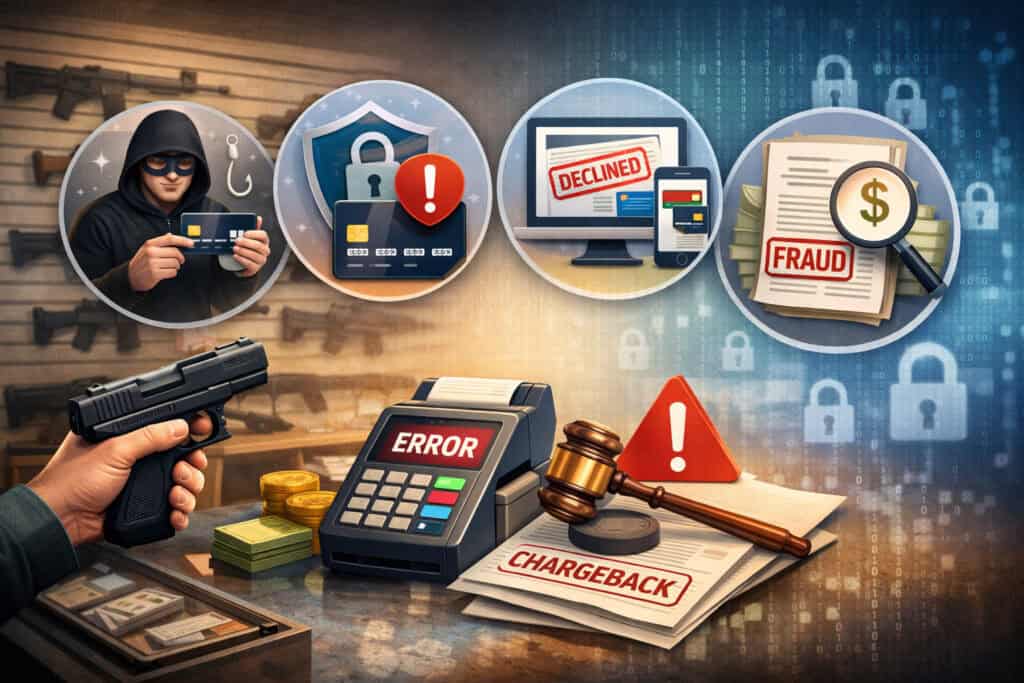
Every retail business that accepts cards faces some level of fraud and payment risk. Firearms and weapons retailers often face a more complicated version of that risk. The combination of higher scrutiny, higher-ticket sales, card-not-present exposure, and policy sensitivity makes secure setup especially important.
The most common threats include fraud, chargebacks, account freezes, rolling reserves, compliance failures, and provider restrictions. These issues are not separate. They often connect. For example, poor checkout disclosures can increase chargebacks.
Rising chargebacks can trigger processor concern. Processor concern can lead to reserve increases or funding delays. A weak fraud setup can start the whole chain.
The good news is that most of these risks can be reduced. They may not disappear entirely, but retailers can control a large part of their exposure by choosing the right merchant account, using strong fraud tools, documenting transactions well, and maintaining clean operating practices.
Understanding the risk landscape helps you make better decisions. It becomes easier to evaluate providers, set internal procedures, and spot weak points before they become expensive.
Fraud, card-not-present risk, and suspicious transaction behavior
Fraud is one of the most immediate payment threats for online and remote sellers. Card-not-present transactions are generally riskier because the card is not physically presented and the business cannot inspect it in person.
That makes it easier for stolen credentials, unauthorized purchases, or synthetic identity attempts to slip through if controls are weak.
This is where fraud prevention tools matter. AVS helps verify whether the billing address matches issuer records. CVV checks help confirm the buyer has the physical card details. Velocity filters can flag repeated attempts from the same user or device.
Transaction monitoring can identify unusual purchasing patterns, inconsistent location signals, or mismatched order behavior.
Fraud does not always look dramatic. Sometimes it appears as a legitimate order with rushed shipping requests, mismatched email and billing details, or repeated attempts using slight card variations. Staff training matters here too. Employees should know how to spot risky patterns instead of approving every order automatically.
For many retailers, the right approach is layered protection rather than one single fraud tool. A combination of gateway settings, manual review rules, tokenization, encryption, and clear checkout verification steps tends to work better than relying on one filter alone.
Chargebacks, account freezes, and compliance-related disruptions
Chargebacks are more than customer disputes. They are one of the key signals processors watch when evaluating account health. Too many disputes can damage your processing profile, increase reserve requirements, or prompt account reviews. In serious cases, they can contribute to account termination.
Many chargebacks come from preventable problems. The customer may not recognize the billing descriptor. The product description may have been unclear. Return rules may not have been displayed prominently.
Delivery expectations may have been misunderstood. In other cases, fraud is the cause, which is why chargeback prevention and fraud prevention should be treated together.
Account freezes and funding holds often happen when processors see unexpected risk. That can include sudden spikes in volume, unusually large tickets, excessive refunds, elevated chargebacks, or underwriting discrepancies. If your application says one thing and your actual transaction pattern says another, you may attract unwanted review.
Merchant account compliance plays a major role here. Your provider should know how you operate. Your website should have clear policies. Your checkout should reflect the actual products and order flow.
Your supporting documents should be accurate and up to date. Secure payment processing is not only about technology. It is also about consistency between what you tell the processor and how the business really runs.
The Core Components of Secure Firearms Payment Processing
A strong payment setup is built from several connected parts, not one product. The merchant account, payment gateway, POS system, virtual terminal, fraud stack, and security controls all work together. If one part is poorly matched to the business, the system becomes less effective and less stable.
For firearms retailers, this matters because different sales channels introduce different risks. In-store transactions need dependable terminals and secure point-of-sale tools.
Online orders need a strong firearms payment gateway, secure checkout experience, and layered fraud controls. Phone orders require careful virtual terminal procedures. Special orders and high-ticket transactions may require manual review and stronger documentation.
The goal is not to make checkout difficult. It is to create a flow that is secure, efficient, and appropriate for the level of risk. The best systems reduce friction for legitimate customers while making it harder for fraudulent transactions to get through.
When evaluating Payment Processing for Gun Stores, it helps to think in terms of infrastructure. What tools do you need? How do they connect? Where are the security gaps most likely to appear? That approach leads to better decisions than focusing only on rates or hardware.
Merchant accounts, payment gateways, and processor relationships
The merchant account is the foundation of card acceptance. It is the account structure that allows your business to accept card payments and receive settlement funds. For firearms and weapons retailers, getting the right high-risk merchant account can make the difference between long-term processing stability and ongoing account stress.
The payment gateway is the technology layer that sends transaction data securely between your checkout, the processor, and the card networks. For online businesses, gateway quality matters a great deal.
A good gateway should support fraud rules, secure integrations, tokenization, reporting, and a checkout experience that feels smooth and trustworthy.
The processor relationship ties these elements together. A retailer may hear terms like acquirer, provider, merchant services company, and gateway partner. While the structure can vary, what matters most is whether the parties involved understand the business and support the way it sells.
Merchant account approval depends on factors such as product type, website quality, processing history, chargeback record, average ticket size, and operational clarity. Some providers may require reserves.
Others may ask for more documentation during underwriting. None of this is unusual in higher-risk categories, but it should be discussed early.
A secure and stable setup starts with transparency. The provider should know what you sell, how you sell it, and what your projected volumes look like. If the merchant account is structured properly, the rest of the payment stack is much easier to manage.
POS systems, virtual terminals, and secure payment channels
Retailers often process payments through more than one channel. In-store firearms payments may happen through a countertop terminal or integrated POS system. Online orders run through a payment gateway.
Phone orders may go through a virtual terminal. Special orders may involve deposits, balance payments, or delayed fulfillment. Secure processing requires each channel to be handled correctly.
A modern POS system should support secure credit card processing, user permissions, transaction tracking, refund controls, and hardware that meets current security expectations. It should also keep workflows organized so staff can process sales consistently and reduce errors that lead to disputes later.
A virtual terminal for firearm retailers can be useful for manually entered payments, especially when handling phone orders, invoices, or special transactions. But manual entry increases risk, so it should be used carefully.
Staff should follow verification procedures, document the order clearly, and use fraud review steps before completing questionable transactions.
Online channels need the strongest protection because card-not-present risk is highest there. Secure online checkout should include SSL protection, AVS and CVV verification, fraud filters, tokenization, and order review rules. The checkout flow should also make billing, shipping, and policy information easy to understand.
How Payment Processing for Gun Stores Works Across Different Sales Channels
Firearms retailers rarely operate through a single type of transaction. One store may handle walk-in sales, online accessory purchases, phone orders, deposits for special items, and follow-up payments for customer pickups.
Another may rely heavily on eCommerce, special orders, and customer service payments through a virtual terminal. Each channel affects risk, authorization flow, and fraud exposure differently.
That is why Payment Processing for Gun Stores should be designed around real transaction patterns, not generic retail assumptions. A setup that works beautifully for in-store traffic may leave online orders exposed.
A gateway that supports eCommerce may not help much if staff handle many manually keyed transactions without clear procedures.
The safest approach is to treat every payment channel as part of one secure operating system. The merchant account, gateway, POS, terminal settings, checkout policies, and fraud controls should work together.
When the system is aligned, staff can process payments more confidently, customers experience fewer issues, and the business becomes less vulnerable to chargebacks and account concerns.
This also improves operational efficiency. Clear channel-specific workflows reduce confusion and help the business know when to automate, when to review manually, and when to decline a transaction.
In-store sales, online orders, and phone payments
In-store transactions are usually the most straightforward because the card is present and the customer is physically there. Secure card terminals, EMV-capable hardware, and clear receipt handling reduce risk.
Even here, though, the store still needs proper permissions, refund procedures, and transaction logging to avoid disputes and staff mistakes.
Online orders introduce more complexity. The customer is not physically present, so the system must rely on verification tools and checkout design.
A secure checkout experience should ask for accurate billing information, verify CVV, run AVS, apply fraud filters, and encrypt transaction data. Product descriptions, shipping policies, return terms, and customer support details should all be visible to reduce confusion.
Phone payments sit somewhere in the middle. They can be useful for special orders, balances due, or customers who need assistance. But manually entered cards carry higher risk.
Retailers using a virtual terminal should verify customer details carefully, document the order terms, and avoid taking shortcuts with identity checks or policy disclosures.
Across all three channels, consistency matters. If your in-store policy says one thing and your online checkout says another, disputes become more likely. If your processor sees higher-risk transaction patterns than expected, that can also create problems. Well-defined procedures protect both revenue and account health.
Special orders, delivery flows, recurring billing, and high-ticket transactions
Special-order transactions often require more careful handling because fulfillment may happen later, products may need to be sourced, and customer expectations can vary. The payment flow should be clear.
Is the customer paying a deposit, partial payment, or full amount? When is the charge submitted? What happens if timelines change? The more clearly this is explained, the lower the dispute risk.
Delivery-related flows also need careful setup. Customers should know exactly when payment is captured, when the order is considered final, and what documentation they will receive. If there are steps between order placement and completion, the payment process should reflect those steps clearly rather than relying on vague assumptions.
Recurring billing is less common for some retailers but may apply to memberships, service plans, storage-related fees, or other ongoing charges.
In those cases, tokenization is especially valuable because it allows future billing without storing raw card data. Customers should consent clearly, billing intervals should be visible, and cancellation rules should be easy to understand.
High-ticket transactions deserve extra review. Large orders attract more fraud risk and more processor scrutiny. Retailers should consider manual review, customer verification, transaction monitoring, and detailed documentation before completing them. Strong records help with both fraud prevention and chargeback response.
How Firearms Merchant Payment Solutions Improve Security, Trust, and Efficiency
A good payment setup does not just reduce risk. It also improves how the business runs. Strong Firearms Merchant Payment Solutions can make approvals more stable, simplify transaction handling, improve customer confidence, and reduce staff confusion at the point of sale or during order review.
This is especially important in a retail environment where trust matters. Customers want checkouts to feel secure and professional. Staff want tools that are easy to use and policies they can follow without guessing. Owners want consistent deposits, lower dispute rates, and fewer surprises from their processor. Secure payment acceptance supports all three groups.
Operational efficiency is often overlooked in payment discussions. Business owners naturally focus on rates, fees, and risk. But a poorly designed system also costs time. Staff may waste hours handling avoidable declines, refund errors, unclear order statuses, or missing documentation during disputes. The right system removes that friction.
The value of a specialized provider often becomes clearest after onboarding. When questions come up about fraud settings, reserves, high-ticket transactions, gateway updates, or compliance details, experience matters. A provider that understands the business can often resolve issues faster and more realistically.
Building customer trust through secure checkout and visible safeguards
Payment security affects customer behavior. Shoppers are more likely to complete a purchase when the checkout flow feels legitimate, organized, and transparent. A messy checkout page, weak policy language, broken address validation, or unclear order confirmation can increase hesitation and cart abandonment.
Trust starts with presentation. Your website should clearly explain what the customer is buying, what they will be charged, what to expect after payment, and how to contact support. The checkout should be secure, mobile-friendly, and free from confusing steps.
Billing descriptors, order confirmation emails, and receipts should all match the brand clearly enough that customers recognize the transaction later.
Visible safeguards also matter. Customers may not understand tokenization or transaction monitoring, but they do notice SSL-secured pages, clean forms, clear policy links, and professional order communication. Those details reduce uncertainty and make it easier for legitimate buyers to complete the process confidently.
In-store trust matters too. Reliable terminals, consistent staff procedures, and clean receipts all contribute to a stronger payment experience. Security does not have to feel cold or complicated. It can simply feel organized and dependable, which is exactly what most customers want.
Improving daily operations with better integrations and reporting
Secure payment systems should make business operations smoother, not harder. Integrated gateways and POS tools can help track sales, refunds, order statuses, and transaction patterns in one place. That makes it easier to identify fraud trends, respond to disputes, and manage cash flow with fewer manual steps.
Payment gateway integration is especially useful for retailers that sell both in-store and online. It can reduce duplicate entry, improve reporting consistency, and make reconciliation easier. If the POS, gateway, and back-office tools work together well, the staff spends less time piecing together transaction history and more time serving customers.
Reporting also matters for risk management. Good visibility into decline rates, chargeback activity, refund trends, average ticket size, and suspicious transactions helps the business make better decisions. You cannot manage risk well if you cannot see it clearly.
Some retailers also benefit from user-level controls. For example, staff may be allowed to process sales but not key in manual payments without approval. Managers may review high-value refunds or unusual transaction attempts. These controls help reduce internal mistakes and create a more secure payment environment overall.
How to Strengthen Gun Store Payment Processing With Security and Fraud Controls
A secure payment environment is built through layers. No single feature can prevent every fraud attempt or every dispute. The strongest Gun Store Payment Processing setups use multiple controls that work together, including PCI compliance, AVS, CVV, tokenization, encryption, SSL, and transaction monitoring.
These tools are most effective when they are matched to actual business risk. A store with strong in-person volume may prioritize terminal security and staff controls.
A retailer with a large eCommerce channel may need more robust fraud filters, device analysis, manual review rules, and secure online checkout features. The objective is not maximum friction. It is smart friction where risk is higher.
Payment security also has a maintenance side. Controls should be reviewed periodically, especially if the business launches new products, adds sales channels, changes platforms, or sees new fraud patterns. A setup that worked well a year ago may not be enough today if the order profile has changed significantly.
Retailers that take a layered approach usually experience fewer costly surprises. Fraud attempts are caught earlier, disputes are easier to fight, and processor relationships tend to remain healthier.
PCI compliance, tokenization, encryption, and SSL
PCI compliance is a baseline requirement for businesses that accept card payments. It is not optional, and it is not just a paperwork exercise. PCI standards help reduce the risk of cardholder data exposure by establishing security expectations for how payment information is handled, transmitted, and stored.
For many retailers, the most practical way to support PCI compliance is to avoid storing sensitive card data directly whenever possible. That is where tokenization becomes extremely useful.
Tokenization replaces sensitive card information with a non-sensitive token that can be used for future billing or internal reference without exposing the actual card number.
Encryption protects payment data while it is being transmitted. This makes it much harder for unauthorized parties to intercept usable information during processing.
SSL adds an important layer for online stores by securing the connection between the customer’s browser and the website. Without SSL, online checkout security is fundamentally weak.
Together, these controls support payment security for firearms businesses by reducing exposure at multiple stages. They help protect the customer, the merchant, and the payment relationship. They also improve trust because secure systems are more professional and less prone to failure.
AVS, CVV checks, fraud filters, and transaction monitoring
AVS and CVV checks are among the most common fraud prevention tools in online and manually keyed transactions. AVS compares the billing address submitted by the customer with the address on file at the issuing bank.
CVV helps verify that the customer has the card details in hand. Neither tool is perfect on its own, but both provide valuable signals.
Fraud filters add another layer. These can include rules for order amount thresholds, repeat attempts, mismatched data, unusual location indicators, email risk signals, or device inconsistencies. The goal is not to decline every transaction that looks slightly unusual. It is to flag orders that deserve review before approval.
Transaction monitoring helps you see patterns over time. A single order may not look dangerous, but multiple attempts from the same source, repeated declines, or clusters of suspicious activity can reveal broader fraud behavior. Monitoring also helps you adjust your rules instead of leaving the fraud setup static.
Retailers should review fraud settings regularly. Too few controls increase exposure. Too many can block good customers and hurt conversions. Strong providers help merchants tune settings based on real performance, not guesswork.
How to Choose the Right Processor and Avoid Common Setup Mistakes
Choosing a processor is one of the most important decisions a firearms retailer makes. A good provider supports stable growth, secure transactions, and realistic risk management. A poor fit can lead to funding delays, hidden fees, technical frustration, and long-term account uncertainty.
The right choice starts with compatibility. Does the processor support your business model, transaction channels, average ticket size, and fulfillment flow? Can it integrate with your website or POS? Does it provide a true high-risk merchant account if needed? Are reserve expectations explained clearly? What fraud tools are included? These questions matter more than a flashy sign-up process.
Retailers should also look closely at support quality. When a payment issue affects checkout, cash flow, or underwriting, fast and informed help matters. It is better to work with a provider that answers realistic questions clearly than one that sells simplicity but avoids details.
Many payment problems begin with setup mistakes, not malicious intent. Businesses may choose unsupported providers, publish weak website disclosures, ignore fraud settings, or misrepresent their sales model unintentionally during onboarding. These errors can become expensive later.
What to look for in a compatible and secure processor
A processor should understand both risk and retail reality. That means being honest about underwriting, reserves, fraud exposure, and documentation requirements. If approval is offered with no real discussion of the business model, the relationship may be less stable than it appears.
Look for signs of long-term fit. A compatible provider should be able to support in-store transactions, online sales, virtual terminal payments, and any other channel you actually use. It should also offer a payment gateway integration that works well with your store platform and security needs.
Ask about merchant account approval criteria. Find out whether there are rolling reserves, funding delays for higher-risk transactions, or volume thresholds that trigger additional review. Good providers do not hide these topics. They explain them in advance so the merchant can make informed decisions.
Also review fraud prevention tools carefully. Some providers include only basic AVS and CVV support, while others offer richer fraud prevention tools, transaction monitoring, rule-based screening, and tokenization. Choose based on your actual risk level, not the minimum needed to get started.
Common mistakes that lead to unstable processing
One of the biggest mistakes is using a provider that does not truly support the business category. A quick approval may feel convenient, but if the account later gets flagged as unsupported, the retailer can face serious disruption. It is better to go through proper underwriting upfront than deal with unexpected account problems later.
Another common issue is weak website compliance. Missing refund terms, unclear shipping policies, poor contact information, and vague product details can increase both disputes and underwriting concern. The website is often part of the payment review process, and it should reflect a real, well-managed business.
Some merchants also underuse fraud tools. They may turn off AVS mismatches, ignore repeated suspicious attempts, or fail to review high-risk orders. Others go too far in the other direction and create unnecessary checkout friction that hurts sales. The right balance comes from monitoring results and adjusting settings thoughtfully.
Hidden fees and mismatched setup are additional risks. A merchant may choose a provider based on one rate while overlooking gateway fees, monthly minimums, reserve terms, chargeback fees, or equipment limitations. Price matters, but price without fit is rarely a win.
A Step-by-Step Checklist for Building and Maintaining a Secure Payment Environment
Secure payment acceptance is not a one-time project. It is a system that needs thoughtful setup, regular review, and ongoing improvement. That applies whether you are opening a new business, adding eCommerce to an established store, or replacing an unstable provider.
The strongest approach is to build from the ground up. Start with a compatible merchant account and processor. Add the right technology stack. Configure fraud and security settings carefully. Document internal procedures.
Then review the system regularly based on actual transaction behavior, customer feedback, and processor communication.
This process helps both new and established retailers. Newer businesses can avoid expensive mistakes early. Established retailers can strengthen weak points, reduce unnecessary friction, and improve approval stability over time. The checklist below is designed to be practical, not theoretical.
Step-by-step setup checklist
Start with the account and provider foundation:
- Confirm the processor supports firearms-related business activity before onboarding
- Apply for the right high-risk merchant account if your business model requires it
- Share accurate details about products, transaction channels, average ticket size, and projected volume
- Ask about reserves, underwriting timelines, settlement terms, and chargeback thresholds
Build the technology stack carefully:
- Choose a secure firearms payment gateway with fraud tools and good integration support
- Use a POS system that supports secure in-store firearms payments and proper user permissions
- Set up a virtual terminal only if you need it, and restrict access to trained staff
- Make sure your checkout pages use SSL and secure hosted payment technology where possible
Strengthen fraud and data protection:
- Enable AVS and CVV checks for online and manually entered transactions
- Use tokenization instead of storing raw card data
- Apply encryption across payment transmission points
- Set up fraud filters and transaction monitoring rules for unusual behavior
- Create manual review procedures for high-value or suspicious orders
Improve customer clarity and chargeback prevention:
- Publish clear refund, return, shipping, and support policies
- Use a recognizable billing descriptor
- Send prompt order confirmations and receipts
- Keep product descriptions and fulfillment expectations specific and accurate
Maintain and review the environment:
- Monitor chargebacks, refunds, and fraud alerts every month
- Review gateway settings and checkout friction regularly
- Update staff procedures when you add new sales channels
- Revisit processor fit if your business model or volume changes significantly
Ongoing maintenance for long-term stability
After setup, maintenance becomes the key to long-term success. Payment risk changes over time. Fraud tactics evolve. Your sales mix may shift. A new product category or order pattern may affect underwriting assumptions.
That is why secure payment acceptance should be reviewed as an ongoing business function rather than an install-and-forget tool.
Schedule regular reviews of your chargeback ratio, refund rate, fraud alerts, and decline patterns. Look for trends, not just incidents. If a certain transaction type produces more disputes, refine that workflow.
If checkout abandonment increases after adding new security steps, test whether some friction can be reduced without weakening protection.
Staff training should also be ongoing. Employees need to know how to handle card-present versus card-not-present transactions, when to escalate suspicious orders, and how to explain policies consistently. Even strong technology can be undermined by inconsistent human handling.
Stay in communication with your provider too. If your volume increases, you add new channels, or your average ticket size changes, let them know. Sudden unexplained shifts can trigger review. Proactive communication helps protect account stability.
General-Purpose Processors vs. Industry-Aware Providers: A Balanced Comparison
When evaluating payment options, many retailers compare mainstream general-purpose processors with gun-friendly or industry-aware providers. Both can have strengths, but they serve different types of businesses and risk profiles.
The right choice depends on how you sell, how much you process, and how important long-term underwriting clarity is to your operation.
General-purpose processors often win on simplicity. They may offer quick onboarding, easy hardware access, and polished user interfaces. For businesses with straightforward transaction patterns and limited exposure, that convenience can be attractive. Some retailers may even process successfully for a period without issue.
Industry-aware providers usually win on fit. They are more likely to understand the operational and underwriting needs of firearms retailers and offer solutions built around those realities. That can mean better merchant account structure, clearer reserve expectations, more appropriate fraud tools, and stronger long-term stability.
Neither category should be judged only by branding. What matters is whether the provider truly supports your business model. The comparison should be based on underwriting transparency, gateway compatibility, security controls, customer support, fee clarity, and how well the provider handles real-world risk.
When general processors may work and where they often fall short
A general-purpose processor may work for a retailer with a narrow transaction profile, modest volume, and limited channel complexity. If the business sells mostly in person, has low dispute activity, and fits within the processor’s accepted risk model, the arrangement may function reasonably well.
The challenge is that some businesses outgrow the fit. As volume rises, online sales expand, average ticket size increases, or underwriting becomes more detailed, the processor may become less comfortable with the account. That can lead to additional document requests, reserve changes, delayed funding, or other restrictions.
Another limitation is tool depth. Some general processors focus on streamlined user experience more than flexible risk controls. For a retailer that needs custom fraud rules, nuanced gateway behavior, or close underwriting communication, that simplicity can become restrictive.
This does not make general processors bad. It simply means they are not always designed for categories where business model fit and account stability need closer attention.
Why industry-aware support often makes more sense for higher-risk retail
Industry-aware providers are usually a stronger fit when the business has higher-risk characteristics, multiple sales channels, larger average tickets, or a need for stable long-term underwriting support. Their value comes from recognizing risk honestly and helping the merchant build around it instead of pretending it does not exist.
That support may include better guidance on website readiness, stronger fraud prevention tools, reserve transparency, manual review practices, and gateway compatibility for more complex checkout flows. It may also mean fewer surprises because the provider already understands the business category.
For many retailers, the real benefit is confidence. When the account is structured appropriately, owners spend less time worrying about surprise freezes, payment incompatibility, or unexplained policy issues. They can focus more on operations, service, and growth.
The best choice is the one that matches the business realistically. Convenience matters, but stability matters more when payment acceptance is critical to daily operations.
FAQ
Q.1: What is Secure Firearms Payment Processing?
Answer: Secure Firearms Payment Processing is the use of payment systems, merchant accounts, gateways, and security controls that allow firearms-related businesses to accept payments safely and reliably. It includes data protection, fraud prevention, chargeback reduction, secure checkout design, and long-term processor compatibility.
Q.2: Why do firearms retailers often need specialized payment providers?
Answer: Many standard processors are built for lower-risk retail categories and may not be comfortable with firearms-related transactions over time. Specialized or gun-friendly payment processors are often better prepared to underwrite these businesses accurately, support their sales channels, and provide stronger long-term account stability.
Q.3: What is a high-risk merchant account?
Answer: A high-risk merchant account is a merchant account designed for businesses that face greater payment risk, underwriting scrutiny, or chargeback exposure. Firearms retailers may need one depending on their transaction mix, online sales activity, average ticket size, and processor policies.
Q.4: How can gun stores reduce chargebacks?
Answer: Gun stores can reduce chargebacks by using clear billing descriptors, publishing strong refund and fulfillment policies, sending prompt order confirmations, documenting transactions carefully, and using fraud prevention tools such as AVS, CVV checks, and transaction monitoring. Fast customer service also helps resolve confusion before it becomes a dispute.
Q.5: What fraud tools are most important for online firearms payments?
Answer: Key fraud prevention tools include AVS, CVV checks, tokenization, encryption, SSL, velocity controls, rule-based fraud filters, and transaction monitoring. High-value or unusual orders should also go through manual review to reduce card-not-present risk.
Q.6: Is PCI compliance enough to keep payment processing secure?
Answer: No. PCI compliance is essential, but it is only one part of security. Retailers also need strong fraud controls, secure gateway integration, tokenization, encryption, clear policies, and ongoing monitoring. A PCI-compliant store can still experience fraud, chargebacks, or processor issues if other controls are weak.
Q.7: What is a firearms payment gateway?
Answer: A firearms payment gateway is the technology that securely transmits online transaction data between the customer checkout, the processor, and the card networks for a firearms-related business. A strong gateway should support payment security, fraud tools, tokenization, and smooth integration with the retailer’s website or platform.
Q.8: Can firearms retailers use a virtual terminal?
Answer: Yes, many do. A virtual terminal for firearm retailers can be useful for phone orders, invoice payments, special-order deposits, and customer service transactions. Because manually entered payments carry more risk, staff should verify order details carefully and follow clear internal procedures.
Q.9: What causes merchant account freezes or fund holds?
Answer: Common causes include high chargeback rates, suspicious transaction activity, sudden spikes in volume, unusually large tickets, underwriting discrepancies, or processor concern about compliance issues. These risks can be reduced through strong setup, clear communication with the processor, and regular transaction monitoring.
Q.10: How should a retailer choose the best payment processor?
Answer: A retailer should choose a processor based on business model compatibility, underwriting transparency, fraud prevention tools, payment gateway integration, reserve clarity, support quality, and overall stability. The best choice is usually the provider that understands the business clearly and can support it consistently over time.
Conclusion
Secure Firearms Payment Processing is about much more than protecting card data. It is about building a payment environment that supports stable growth, customer trust, fraud control, and long-term account reliability. For firearms and weapons retailers, that matters because payment disruption can affect every part of the business.
The strongest setups are built on honest underwriting, the right merchant account, a reliable firearms payment gateway, secure checkout design, strong fraud prevention tools, and clear operating procedures.
They support in-store sales, online orders, phone payments, special orders, and high-ticket transactions without relying on guesswork. They also reduce the chances of avoidable chargebacks, account reviews, and customer confusion.
For both new and established retailers, the goal is not to chase the fastest approval or the lowest advertised rate. It is to choose a payment environment that actually fits the business and can continue supporting it over time.
A provider that understands the category, explains risk clearly, and offers the right security controls is often worth far more than a simple sign-up promise.
When done well, Payment Processing for Gun Stores, Gun Store Payment Processing, and Payment Processing for Weapons Retailers become more than back-office functions. They become tools for protecting revenue, improving daily operations, and giving customers a checkout experience they can trust.