

High-risk businesses often pay different processing fees because processors evaluate more than sales volume. They look at underwriting risk, chargeback exposure, fraud patterns, online sales activity, refund frequency, recurring billing, ticket size, and how predictable the business model is.
For merchants in higher-risk categories, payment acceptance is not just about getting approved. It is about understanding the full cost structure behind approval, daily processing, settlements, reserves, disputes, and account stability.
Understanding payment processing fees for high-risk merchants helps business owners make better decisions before signing a contract, comparing providers, or scaling online sales. It also helps prevent surprises such as reserve holds, gateway add-ons, chargeback penalties, and pricing increases after account review.
High-risk pricing is rarely one simple rate. It usually includes transaction fees, monthly service fees, gateway fees, compliance-related costs, risk monitoring, and possible reserve requirements. The more organized and transparent the business is during underwriting, the easier it becomes to negotiate fairer terms.
What Are Payment Processing Fees for High-Risk Merchants?
Payment processing fees are the costs a business pays to accept card payments, digital payments, and other electronic transactions. For high-risk merchants, these fees may be higher or more layered because the processor is taking on additional financial exposure.
If a customer disputes a payment, if fraud occurs, or if the merchant cannot cover refunds, the processor may be responsible for losses.
At a basic level, payment processing fees for high-risk businesses usually include a percentage of each transaction plus a small fixed fee.
For example, a merchant may pay a percentage-based markup on each sale along with a per-transaction fee. This structure helps cover card network costs, processor costs, risk monitoring, authorization, settlement, and account support.
Beyond transaction costs, high-risk merchant account fees may include monthly account fees, payment gateway fees, PCI-related fees, batch fees, statement fees, chargeback fees, reserve requirements, and early termination fees. Some businesses also pay for fraud tools, recurring billing features, advanced reporting, virtual terminals, or ecommerce integrations.
High-risk transaction processing fees can vary widely because each account is underwritten differently. A business with clean financial records, low dispute ratios, stable sales history, and strong fraud controls may receive better pricing than a business with inconsistent volume, frequent refunds, unclear policies, or a history of chargebacks.
A major part of understanding payment processing fees for high-risk merchants is knowing which costs are unavoidable and which costs may be negotiable. Interchange and card network costs are generally passed through in some form. Processor markups, gateway fees, reserve terms, monthly fees, and contract terms may have more room for discussion.
For more background on how risk-based processing works, this guide on how high-risk payment processing works is a useful supporting resource.
Why High-Risk Merchants Usually Pay Higher Fees
High-risk merchants usually pay higher fees because processors must account for greater potential losses. A standard merchant account may have predictable transaction patterns, low refund rates, low dispute volume, and stable monthly sales.
A high-risk account may involve higher ticket sizes, card-not-present sales, recurring billing, regulated products, cross-border transactions, subscription models, or industries with above-average chargeback activity.
Chargebacks are one of the biggest reasons pricing increases. When a customer disputes a payment, the merchant may lose the sale amount, pay a chargeback fee, and spend time submitting evidence.
Excessive disputes can also put the merchant account under review. Consumer dispute rights and billing-error processes are recognized in official consumer guidance, which is why merchants need clear policies and accurate documentation.
Fraud exposure also affects high-risk credit card processing costs. Online transactions are harder to verify than in-person payments because the cardholder and card are not physically present. Processors may price these transactions higher because they require stronger fraud screening, address checks, velocity controls, device monitoring, and manual review tools.
Underwriting also plays a major role. A processor may review ownership details, business history, websites, refund policies, fulfillment practices, processing volume, chargeback history, financial stability, and compliance posture. If anything appears unclear or inconsistent, the account may receive higher pricing, stricter limits, delayed settlement, or rolling reserve fees.
| Fee Type | What It Covers | Why It Applies to High-Risk Merchants | Ways to Reduce the Cost |
| Transaction fees | Authorization, processing, settlement, and processor markup | Higher-risk transactions require more monitoring and support | Reduce disputes, improve approval quality, review pricing models |
| Interchange costs | Card network and issuing bank costs | Card type, rewards cards, and card-not-present sales can raise costs | Encourage secure checkout and reduce manual entry |
| Gateway fees | Online payment gateway access and ecommerce tools | High-risk ecommerce often needs stronger fraud controls | Use only needed gateway features and monitor gateway add-ons |
| Rolling reserves | Funds held to protect against future losses | Processors use reserves to offset chargebacks, refunds, and fraud | Build processing history and negotiate reserve reviews |
| Chargeback fees | Administrative cost of handling disputes | Disputes are more common in many high-risk sectors | Improve billing descriptors, policies, tracking, and support |
| Monthly fees | Account maintenance and service | High-risk accounts may require enhanced monitoring | Compare full monthly cost, not just rates |
| Underwriting fees | Application review and risk assessment | Complex business models require deeper review | Provide complete documents upfront |
| Fraud tool costs | Screening, filters, alerts, and monitoring | Higher fraud exposure requires extra protection | Use targeted tools instead of unnecessary add-ons |
Transaction and Interchange Fees
Transaction and interchange fees are usually the most visible part of payment processing. A merchant may see a percentage rate, a fixed per-transaction amount, or both. These costs apply whenever a customer pays by card or another supported electronic method.
Interchange is influenced by factors such as card type, transaction method, card-present or card-not-present status, rewards card usage, business category, and authorization quality. Ecommerce payment processing costs are often higher than in-person costs because online transactions carry greater fraud and dispute risk.
Card-not-present payments usually cost more because the processor cannot physically verify the card. Keyed transactions may cost more than properly captured online transactions because manual entry can increase fraud exposure and data-entry errors. Rewards cards and business cards may also carry higher interchange costs than basic debit or standard credit products.
International or cross-border activity can add another layer of cost. Currency conversion, additional network assessments, fraud screening, and regulatory review can all affect pricing. For high-risk merchants, these costs may be more noticeable because cross-border transactions are often monitored more closely.
High-risk credit card processing costs are not determined by a single factor. A merchant with a strong fraud prevention setup, low chargeback ratio, clear fulfillment records, and consistent volume may be viewed more favorably than one with unpredictable patterns.
Rolling Reserves and Risk Holds
A rolling reserve is a portion of each transaction that the processor holds for a set period before releasing it. For example, a processor may hold a small percentage of daily sales and release it after several months, depending on the agreement. The purpose is to create a financial buffer for future chargebacks, refunds, or fraud losses.
Rolling reserve fees are not always “fees” in the traditional sense because the money may eventually be released. However, they still affect cash flow because the business cannot use that portion of revenue immediately.
This can be especially important for merchants with inventory costs, advertising spend, payroll, fulfillment expenses, or seasonal sales cycles.
Processors use rolling reserves when they believe the account has elevated risk. Reasons may include limited processing history, a new business model, high-ticket sales, subscription billing, chargeback concerns, international sales, or inconsistent financial documentation.
Some merchants may also face upfront reserves or capped processing volume until they build a stronger record.
A detailed explanation of reserve structures is available in this resource on rolling reserves. Reserve negotiation strategies may also help merchants understand how better reporting, lower disputes, and stable volume can support improved terms over time.
Chargeback and Dispute Fees
Chargeback fees are charged when a customer disputes a transaction through the card issuer. The fee may apply even if the merchant eventually wins the dispute. That is why chargeback management is one of the most important parts of controlling high-risk transaction processing fees.
A chargeback can happen for many reasons. The customer may claim fraud, non-delivery, duplicate billing, product dissatisfaction, cancellation problems, or unclear billing. Some disputes are legitimate. Others may result from confusion, poor communication, delayed shipping, or customers contacting the issuer before contacting the business.
Retrieval requests and refund disputes can also create administrative costs. A retrieval request may require the merchant to provide transaction documentation before the situation becomes a formal chargeback. If a merchant does not respond on time or lacks evidence, the dispute may be harder to win.
Excessive disputes can increase pricing, trigger reserve requirements, delay settlements, or cause account termination. Processors closely watch chargeback ratios because they indicate future risk. Businesses that actively manage disputes often have a stronger chance of maintaining stable high-risk merchant services pricing.
For practical dispute prevention ideas, this guide on handling disputes and chargebacks in high-risk payment processing offers helpful context.
Common High-Risk Merchant Account Fees

High-risk merchant account fees often include more than transaction pricing. Many merchants focus on the discount rate and overlook smaller recurring or event-based fees that can add up over time. Understanding the full schedule helps avoid surprises and gives the business a better basis for comparison.
Monthly account fees are common. These may cover account maintenance, support, reporting access, and risk monitoring. Some providers combine several services into one monthly fee, while others separate them into individual charges. Neither structure is automatically better; what matters is whether the pricing is clear and reasonable for the services included.
High-risk payment gateway fees apply when a merchant accepts online payments. A gateway securely connects the checkout page, shopping cart, processor, and banking network.
Advanced gateway features may include recurring billing, fraud filters, customer vaults, tokenization, reporting, and integrations. These features can be valuable, but merchants should avoid paying for tools they do not use.
PCI-related fees may appear as compliance fees, non-compliance fees, or security program fees. These costs relate to card data protection responsibilities. Merchants should confirm what the fee includes and whether additional action is required to avoid penalties.
Batch fees are charged when transactions are submitted for settlement. Statement fees may cover monthly reporting. Early termination fees may apply if the merchant exits the agreement before the contract term ends. POS equipment costs may include leases, purchases, software subscriptions, or replacement charges.
Fraud prevention tool costs are also common for high-risk businesses. Tools may include address verification, card security code checks, velocity filters, payer authentication, device checks, blacklist rules, and manual review systems. These tools can lower losses, but they should be matched to actual risk.
Factors That Affect High-Risk Credit Card Processing Costs
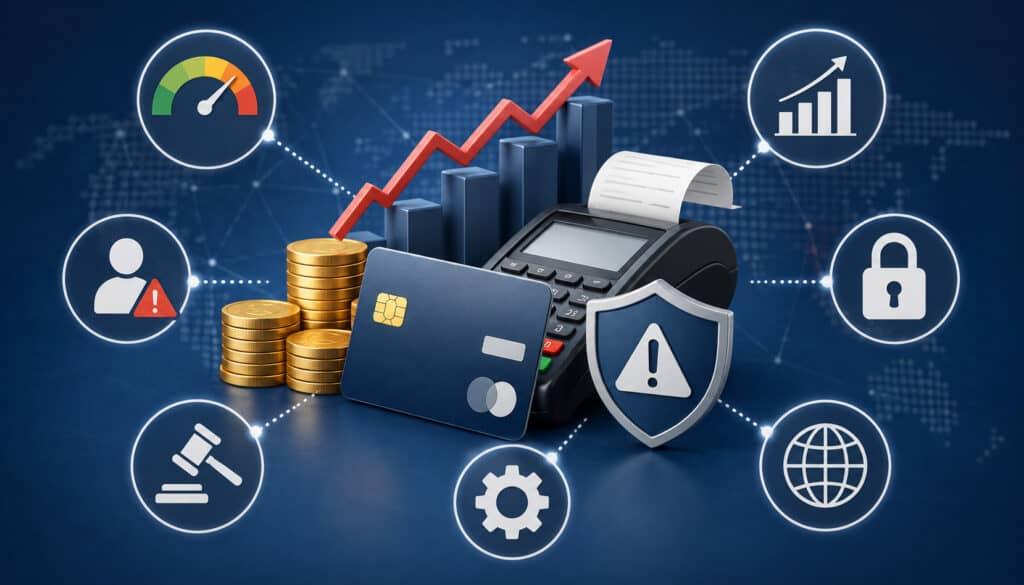
High-risk credit card processing costs are shaped by the processor’s risk assessment. No two businesses are exactly alike, even within the same industry. A processor may approve two similar merchants at different rates because their sales patterns, documentation, dispute history, and operational controls are different.
Industry type is one of the first factors reviewed. Some categories naturally carry more chargeback exposure, delivery complexity, regulatory scrutiny, or fraud risk. Processors may price these accounts higher because the likelihood of disputes or losses is greater.
Processing volume also matters. Higher volume can sometimes support better pricing because the processor earns more total revenue from the account. However, sudden spikes in volume can raise concerns if they are not explained. A merchant that grows too quickly without matching fulfillment capacity may create refund and dispute risk.
Average ticket size is another major factor. High-ticket transactions create more exposure per sale. A few chargebacks on expensive purchases can create a larger financial impact than many low-dollar disputes. Processors may require reserves or tighter controls for high-ticket businesses.
Chargeback history is one of the strongest pricing indicators. A merchant with a clean dispute record may qualify for better terms over time. A merchant with frequent disputes may face higher fees, reserves, volume limits, or additional monitoring.
Business age and financial stability also affect underwriting. Established businesses with organized records, consistent sales, clear policies, and stable cash flow may appear less risky. New businesses may still be approved, but they may start with stricter terms until they build a processing history.
Ecommerce activity adds another layer. Online sales require secure checkout, strong fraud controls, accurate product descriptions, fulfillment tracking, and responsive support. A business that can document these controls is usually in a better position during underwriting.
Ecommerce and Online Payment Costs for High-Risk Businesses

Ecommerce payment processing costs are often higher for high-risk merchants because online transactions create more uncertainty. The customer is not physically present, the card is not physically inspected, and fraud attempts can happen at scale. This is why card-not-present transactions usually require stronger screening and may carry higher fees.
Online merchants often need a payment gateway, shopping cart integration, secure checkout page, fraud filters, recurring billing tools, and reporting dashboards. Each feature can affect cost. Some fees are fixed monthly charges, while others are charged per transaction or as add-ons.
Recurring billing and subscription models require special attention. They can create predictable revenue, but they also increase dispute risk if customers forget billing dates, misunderstand cancellation policies, or do not recognize the billing descriptor. Clear renewal reminders, easy cancellation, and transparent receipts can reduce these problems.
High-risk payment gateway fees may include charges for tokenization, customer vault storage, API access, fraud tools, chargeback alerts, and recurring payment management. These tools may be worth the cost if they reduce fraud and improve payment stability.
Secure checkout systems also affect customer trust. A confusing checkout page can lead to abandoned carts, duplicate attempts, and customer service issues. A clear, secure, mobile-friendly checkout process can improve authorization quality and reduce unnecessary disputes.
For online merchants, transaction monitoring is especially important. Reviewing failed payments, refund patterns, duplicate orders, high-risk locations, mismatched billing details, and unusual velocity can help detect problems before they become chargebacks.
Payment Security and Fraud Prevention Best Practices
Payment security is a core part of managing high-risk merchant services pricing. Strong controls can reduce fraud, lower chargeback exposure, improve underwriting confidence, and support account stability. Security is not only a technical issue; it also involves staff training, access controls, refund procedures, and regular review.
Encryption helps protect payment data during transmission. Tokenization replaces sensitive card data with a token that can be used for future transactions without exposing the original card details. These tools reduce the risk of stored payment data being misused.
PCI-aware workflows are also important. Merchants should avoid unnecessary handling of sensitive card data, use secure systems, and complete required validation steps. Security-related costs may feel like an expense, but weak controls can lead to far greater losses.
Fraud filters help identify suspicious activity. Common filters include address verification, card security code checks, transaction velocity limits, payer authentication, device screening, and rules for mismatched billing and shipping information. The goal is not to block every unusual transaction automatically, but to route higher-risk transactions for review.
Secure checkout pages should be clear, consistent, and trustworthy. Customers should understand what they are buying, how much they are paying, when they will be billed, and how to contact support. Confusion can lead to disputes even when no fraud occurred.
User permissions matter too. Not every employee should have access to refunds, payment settings, customer vaults, or reporting tools. Role-based permissions reduce internal risk and help prevent accidental or unauthorized actions.
Refund controls can also reduce losses. Businesses should define who can issue refunds, when approval is needed, how refunds are documented, and how customers are notified. Consistent refund procedures can prevent duplicate refunds and unnecessary disputes.
How High-Risk Merchants Can Reduce Processing Fees
High-risk merchants can reduce processing fees by lowering the risk signals that processors care about most. While not every fee is negotiable, many pricing factors improve when the business demonstrates stable processing, low disputes, organized records, and strong fraud controls.
The first priority is reducing chargebacks. Clear product descriptions, visible refund policies, accurate shipping timelines, responsive customer service, and recognizable billing descriptors all help. Customers often dispute charges when they feel confused, ignored, or unable to resolve an issue directly.
Improving customer communication can also reduce payment friction. Send order confirmations, receipts, shipping updates, subscription reminders, cancellation confirmations, and refund notices. These messages create a record that can help prevent disputes and support representation if a chargeback occurs.
Using secure payment gateways can reduce fraud and improve authorization quality. Features such as tokenization, fraud filters, payer authentication, and customer vaults may increase gateway cost, but they can reduce losses and improve account performance.
Reviewing monthly statements is another important habit. Merchants should compare effective rates, transaction downgrades, chargeback fees, gateway costs, statement fees, PCI-related charges, and reserve activity. Small fees can become significant over time.
Reducing manual transactions can also help. Keyed payments often cost more and carry greater risk. Whenever possible, use secure checkout links, hosted payment pages, invoicing tools, or integrated systems that capture better transaction data.
Comparing payment processor pricing models is useful, but merchants should compare the total cost rather than only the rate. Payment processor pricing models may include flat-rate, tiered, interchange-plus, or custom high-risk pricing. Each model can be reasonable or expensive depending on the business profile.
Maintaining organized business records supports better underwriting. Keep financial statements, refund policies, fulfillment records, supplier agreements, licenses, website terms, and chargeback documentation current. A well-documented business is easier to evaluate and may receive better terms over time.
Additional strategies for reducing transaction costs are discussed in this guide on saving on transaction fees in high-risk sectors.
Common Mistakes High-Risk Businesses Make With Merchant Fees
One of the most common mistakes high-risk businesses make is choosing a processor based only on advertised rates. A low headline rate can become expensive if the account includes high monthly fees, strict reserves, long contracts, gateway add-ons, excessive chargeback fees, or early termination penalties.
Another mistake is ignoring reserve terms. A rolling reserve can be manageable when the percentage, hold period, and release schedule are clear. It becomes a problem when the merchant does not understand how much cash will be unavailable or when funds may be released.
Hidden fees are another issue. Some merchants do not notice statement fees, batch fees, PCI non-compliance fees, gateway fees, minimum monthly fees, equipment costs, or annual charges until after approval. A careful review before signing can prevent frustration later.
Weak fraud prevention can also increase costs. Businesses that do not monitor suspicious activity may experience more chargebacks, refunds, and lost inventory. This can lead to pricing increases or account restrictions.
Poor chargeback management is another costly mistake. Some merchants ignore disputes because the process feels time-consuming. However, failing to respond can increase losses and weaken the account’s risk profile. Even when a dispute cannot be won, reviewing the reason code can reveal operational problems.
Not reviewing contracts carefully can create long-term issues. Merchants should look for contract length, cancellation terms, reserve clauses, pricing change language, equipment obligations, and dispute procedures. These terms can matter as much as the transaction rate.
Failing to monitor monthly statements is also risky. Processing costs can change due to volume shifts, card mix, downgrades, refunds, chargebacks, or added services. Monthly review helps catch problems early.
How to Compare High-Risk Merchant Service Providers
Comparing high-risk merchant service providers requires looking beyond rates. The best fit is usually the provider that offers transparent pricing, realistic underwriting, useful risk tools, reliable support, and contract terms that match the business model.
Pricing transparency should come first. A clear proposal should explain transaction rates, per-item fees, gateway costs, monthly fees, chargeback fees, reserve requirements, equipment costs, and cancellation terms. If a quote is vague, ask for clarification before moving forward.
Reserve requirements should be reviewed carefully. Compare the reserve percentage, hold period, release schedule, review process, and triggers that could increase or reduce reserves. A higher transaction rate with no reserve may sometimes be better for cash flow than a lower rate with a large holdback.
Settlement timing is another key factor. Faster settlement supports cash flow, but high-risk accounts may have delayed funding depending on risk level. Merchants should confirm when funds are deposited and whether settlement timing can change after account review.
Ecommerce support matters for online businesses. Look for gateway compatibility, shopping cart integration, recurring billing tools, fraud filters, hosted checkout options, API support, reporting, and support for refunds and disputes.
Fraud prevention tools should match the business model. A subscription business, high-ticket retailer, digital seller, and service provider may need different controls. The provider should understand how to balance fraud prevention with customer approval rates.
Industry experience is important. Providers familiar with high-risk underwriting are more likely to understand documentation, risk controls, and account stability. This can reduce approval friction and prevent mismatched expectations.
Customer support should be accessible and knowledgeable. When payment issues, chargebacks, funding delays, or gateway errors occur, slow support can become expensive.
Contract flexibility should also be considered. Avoid long commitments without understanding termination terms. Ask whether pricing can be reviewed after strong performance.
What are payment processing fees for high-risk merchants?
Payment processing fees for high-risk merchants are the costs charged to accept electronic payments in a business category that processors consider higher risk. These fees may include transaction rates, per-transaction fees, gateway fees, monthly account fees, PCI-related fees, chargeback fees, reserve requirements, and underwriting-related costs.
The exact pricing depends on the business model, sales volume, average ticket size, dispute history, ecommerce activity, fraud controls, and underwriting results. Understanding payment processing fees for high-risk merchants helps business owners compare offers more accurately and avoid focusing only on the advertised rate.
Why do high-risk businesses pay higher fees?
High-risk businesses pay higher fees because processors may face greater exposure to chargebacks, refunds, fraud, regulatory concerns, and account instability. If a merchant cannot cover losses, the processor may be financially responsible.
Higher fees help cover monitoring, underwriting, risk review, fraud tools, dispute handling, and potential losses. Pricing may improve over time if the business maintains stable volume, low chargebacks, strong documentation, and secure payment practices.
What is a rolling reserve?
A rolling reserve is a portion of each transaction held by the processor for a set period. The funds are usually released later according to the reserve schedule. Processors use rolling reserves to protect against future chargebacks, refunds, and fraud losses.
Rolling reserves can affect cash flow because the business does not receive the full transaction amount immediately. Merchants should review the reserve percentage, hold period, release terms, and review process before signing an agreement.
What fees should high-risk businesses watch for?
High-risk businesses should watch for transaction fees, gateway fees, monthly minimums, statement fees, batch fees, PCI-related fees, chargeback fees, refund fees, early termination fees, equipment costs, and reserve requirements.
They should also review optional add-ons such as fraud tools, recurring billing features, customer vaults, and advanced reporting. Some tools are valuable, but unnecessary add-ons can increase costs without improving performance.
Can chargebacks increase processing costs?
Yes. Chargebacks can increase processing costs directly and indirectly. Direct costs include chargeback fees and lost revenue. Indirect costs may include higher processing rates, stricter reserves, delayed settlements, additional monitoring, or possible account termination.
Merchants can reduce chargeback risk by improving billing clarity, customer service, refund procedures, delivery tracking, fraud controls, and dispute response workflows.
How can businesses reduce payment processing fees?
Businesses can reduce payment processing fees by lowering chargebacks, improving fraud prevention, reducing manual transactions, reviewing statements, using secure gateways, keeping accurate records, and comparing pricing models.
They should also ask for periodic pricing reviews after building a stable processing history. Processors may be more willing to review terms when a merchant shows consistent volume, low disputes, and reliable operations.
Are online transactions more expensive?
Online transactions are often more expensive because they are card-not-present payments. This means the card and cardholder are not physically verified at checkout. As a result, online payments may carry higher fraud risk, higher dispute risk, and higher security requirements.
High-risk ecommerce businesses may also pay gateway fees, fraud tool fees, recurring billing fees, and customer vault fees. These costs can be worthwhile if they improve security and reduce losses.
How should businesses compare high-risk processors?
Businesses should compare total cost, not just the advertised rate. Review transaction pricing, monthly fees, gateway costs, reserve terms, settlement timing, chargeback fees, contract terms, fraud tools, ecommerce support, and customer service quality.
A good comparison should use realistic processing numbers. Estimate monthly volume, average ticket size, refund rate, chargeback rate, card-not-present percentage, and needed gateway features before comparing offers.
Conclusion
Understanding payment processing fees for high-risk merchants is essential for controlling costs, protecting cash flow, and maintaining account stability. High-risk pricing is shaped by underwriting risk, chargebacks, fraud exposure, ecommerce activity, transaction patterns, reserve requirements, and the quality of business documentation.
The goal is not simply to find the lowest rate. The goal is to find transparent, stable, and sustainable pricing that supports the way the business actually sells. A low advertised rate can become expensive if reserves, chargeback fees, gateway costs, contract terms, and hidden charges are ignored.
High-risk merchants can improve their cost position by reducing disputes, strengthening fraud prevention, using secure payment gateways, reviewing monthly statements, maintaining organized records, and comparing payment processor pricing models carefully.
When businesses understand high-risk merchant account fees, payment gateway costs, rolling reserve fees, chargeback fees, and underwriting expectations, they are better prepared to negotiate, plan cash flow, and choose payment solutions that support long-term growth.