

By alphacardprocess February 2, 2026
Mobile POS solutions for high-risk merchants have moved from “nice to have” to “business-critical.” If you sell in a regulated category, operate a subscription model, run pop-ups, travel for events, or process card-not-present and card-present in the same week, your payments setup has to do more than swipe and print receipts.
It has to reduce disputes, prove legitimacy, adapt to underwriting rules, keep customer data protected, and still feel effortless at checkout.
That’s why mobile POS solutions for high-risk merchants are evolving quickly: contactless acceptance is rising, phone-based tap acceptance is expanding, and security standards are tightening.
For example, PCI DSS v4.x includes future-dated requirements that become mandatory by March 31, 2025, pushing merchants and providers to improve how they manage payment security and access controls.
In this guide, you’ll learn what makes a merchant “high-risk,” what a modern mobile POS should include, how to pick a provider without getting shut down later, and how to build a checkout flow that protects approvals and reduces chargebacks—without making honest customers jump through hoops.
You’ll also get forward-looking predictions on where mobile POS risk controls are headed next, so you can make decisions that still work a year from now.
What “High-Risk Merchant” Really Means in Mobile POS Processing

High-risk is not a judgment of your business quality—it’s a risk classification used by processors, acquiring banks, and card networks to predict financial exposure.
In mobile POS solutions for high-risk merchants, this classification matters because it directly affects approval rates, funding timelines, reserve requirements, device and feature access, and whether your account stays open long-term.
A merchant is commonly labeled high-risk when there’s a higher probability of disputes, fraud, returns, regulatory action, or sudden volume spikes.
That can happen for many reasons: a business model with recurring billing, higher ticket sizes, cross-border customers, pre-orders, extended fulfillment timelines, “trial-to-paid” offers, or products that generate more “I didn’t authorize this” claims.
In-person sellers can still be high-risk if they operate at temporary events, accept a lot of keyed entries, or sell regulated goods that require strict policies and documentation.
Mobile environments also change the risk picture. When you take payments curbside, at conventions, or during deliveries, you may see more card-present transactions without traditional retail signals (fixed location, stable foot traffic, consistent device/IP patterns).
That can trigger monitoring systems—especially if chargebacks rise relative to sales volume. Card brands run programs that track excessive chargebacks, and your acquirer may require remediation if thresholds are breached.
Why Standard Mobile POS Setups Fail High-Risk Merchants (and How to Spot the Red Flags)
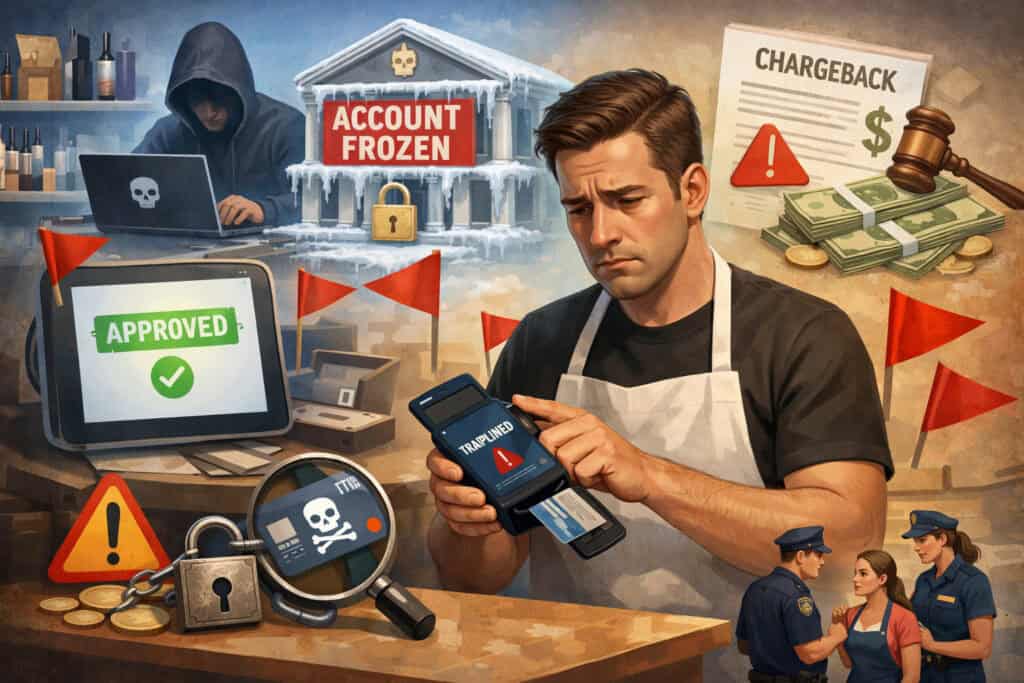
A basic “download-an-app-and-start-selling” reader might work for low-risk retail, but it often fails high-risk merchants in predictable ways. The biggest risk isn’t only higher fees—it’s account instability.
Many merchants discover too late that their provider’s acceptable-use policy or underwriting model doesn’t match their category, their marketing approach, or their fulfillment timeline. When the provider detects “unexpected risk,” they may hold funds, impose sudden limits, or terminate processing.
One common failure point is weak underwriting alignment. If your provider onboards you with minimal questions, that can feel fast—until your volume grows or your dispute ratio changes.
High-risk merchants need a mobile POS that’s comfortable with their category from day one: clear documentation, transparent policies, and a processor that prices and monitors you appropriately instead of reacting later.
Another failure is poor dispute readiness. High-risk merchants don’t just need to “reduce chargebacks”; they need evidence pipelines. That includes clean receipts, verifiable customer authorization, clear refund and cancellation workflows, and order documentation.
Visa’s Compelling Evidence framework (CE3.0) emphasizes the role of prior transaction history and structured evidence pathways in dispute outcomes. Even if you never reference the policy directly, your mobile POS should capture the types of signals that strengthen representation or enable smart “remedy” strategies.
A third failure is feature gaps that force risky workarounds. If your mobile POS can’t support partial refunds, deposits, tips with proper receipts, offline mode safeguards, or digital signatures when needed, your staff may “hack” the process—keying more transactions, splitting tickets unnaturally, or using multiple apps. Those workarounds can raise fraud flags and increase disputes.
If you want mobile POS solutions for high-risk merchants that last, treat simplicity as a goal, but never as the only goal. Stability, evidence, and policy alignment are what keep the lights on.
Core Features Mobile POS Solutions for High-Risk Merchants Must Have Today
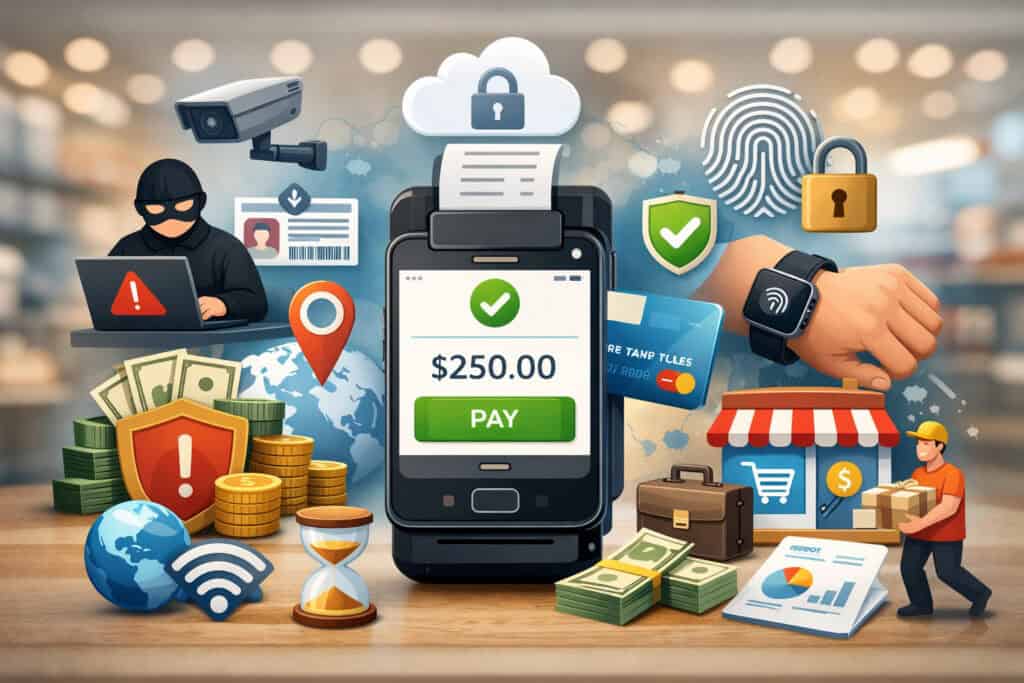
Mobile POS solutions for high-risk merchants should be evaluated like a risk platform, not just a checkout tool. The feature list below isn’t about “nice extras.” These are the fundamentals that protect approvals, reduce disputes, and help you stay compliant as standards tighten.
First, you need multi-method acceptance that prioritizes secure transaction types: EMV chip, contactless wallets, and device-based tap acceptance. Modern contactless options can reduce friction while improving security signals.
Tap to Pay on iPhone, for example, allows merchants to accept contactless payments directly on an iPhone through supported apps, reducing dependency on separate hardware in some scenarios. For mobile sellers, fewer devices can mean fewer operational mistakes—while still supporting secure authentication.
Second, you need risk controls at the POS layer: configurable prompts (ID checks where legal/appropriate), fraud filters, velocity monitoring, and controls for keyed entry versus tap/chip.
High-risk merchants often need different rules for different environments (in-store vs event vs delivery). A POS that can’t adapt forces your team into inconsistent behavior, which is exactly what risk systems dislike.
Third, evidence capture must be automatic. Receipts should include line items, location signals (when available), staff IDs, refund policy links, and customer acknowledgment.
The best mobile POS solutions for high-risk merchants also support attaching notes or documents to sales records (delivery confirmation, service completion, customer communication logs). These details matter when disputes happen weeks later.
Fourth, you need chargeback-aware operations: refund workflows that are easy to execute correctly, cancellation handling for recurring plans, and reporting that highlights dispute patterns.
Card networks monitor excessive chargebacks through structured programs, and your provider’s ability to flag issues early can prevent painful enforcement steps.
Finally, you need security and standards readiness. PCI DSS v4.x includes requirements that become mandatory by March 31, 2025, pushing stronger access controls, better authentication discipline, and more rigorous security hygiene.
Your mobile POS should help you enforce least-privilege access, device security expectations, and clean handling of payment data.
Underwriting, Reserves, and Funding: How High-Risk Mobile POS Accounts Really Work

High-risk merchants often feel like “payments are unpredictable,” but the underlying mechanics are usually consistent once you understand them. Mobile POS solutions for high-risk merchants are tied to merchant accounts that are priced and controlled based on exposure.
Exposure is driven by dispute rates, refund behavior, ticket size, fulfillment speed, and how quickly a merchant could generate losses before a processor can react.
Underwriting is the process where the provider evaluates your business before (and sometimes during) processing. For high-risk categories, underwriting is not only a one-time step. It can be ongoing. Expect requests for product lists, marketing language, refund policies, fulfillment timelines, supplier invoices, and bank statements.
If you sell services, you may be asked for contracts, service terms, and proof of delivery mechanisms. A stable mobile POS setup supports this by keeping your operational reality consistent: what you told underwriting should match what the POS data shows.
Reserves are another common piece. A reserve is money set aside to cover future chargebacks and refunds. Some reserves are rolling (a percentage held and released later), while others are fixed. Reserves aren’t automatically bad—they can be the reason you’re approved when others are declined.
The critical point is predictability: if a provider surprises you with a reserve change midstream, cash flow suffers. The best mobile POS solutions for high-risk merchants come from providers who explain reserve logic upfront and offer paths to reduce it through performance.
Funding schedules can also differ. Low-risk merchants may get next-day funding. High-risk merchants may see longer settlement windows, especially during early months or volume spikes. Card network monitoring programs and dispute risk influence how quickly funds can safely be released.
To succeed, build your operations around clarity: accurate descriptors, consistent transaction patterns, fast fulfillment, and customer communication that prevents “friendly fraud” disputes from becoming a monthly surprise.
Security and Compliance in Mobile POS: What Changed Recently and What’s Next
Mobile POS security isn’t just a technical topic—it’s a business survival topic. High-risk merchants are more likely to be scrutinized, more likely to be asked for documentation, and more likely to feel the impact of new standards earlier than everyone else.
The biggest recent driver is PCI DSS v4.x and its future-dated requirements becoming mandatory by March 31, 2025.
What does that mean practically for mobile POS solutions for high-risk merchants? It means you should expect stronger expectations around access management, authentication, logging, and operational discipline.
If your staff shares logins, uses unmanaged devices, or installs random apps on the same phone used for payments, your risk goes up. Even if your payment provider handles encryption and tokenization, your internal controls still matter—especially if you store customer data elsewhere (email, spreadsheets, notes apps, appointment tools).
Mobile adds another layer: devices get lost, stolen, or replaced. A strong POS program should support role-based access, device-level controls, and rapid deactivation. It should also support audit trails—who processed what, from which device, when. This isn’t bureaucratic; it’s how you prove operational integrity when something goes wrong.
Looking forward, expect mobile POS platforms to move toward continuous compliance cues rather than annual checklists. More systems will warn you when staff behavior increases risk (too many keyed entries, too many post-authorization edits, suspicious refunds), and some providers will bake these “guardrails” into the checkout flow.
We’re also likely to see wider adoption of phone-based contactless acceptance as device ecosystems expand, building on existing Tap to Pay capabilities.
If you’re high-risk, treat security as a competitive advantage: fewer incidents, fewer disputes, and fewer interruptions.
Choosing the Right Mobile POS Provider for High-Risk Merchants Without Getting Shut Down
Selecting mobile POS solutions for high-risk merchants isn’t about picking the most popular app. It’s about picking the most compatible risk relationship. The wrong provider can approve you fast and shut you down later. The right provider might ask more questions upfront—but keep you stable when you scale.
Start with category fit. If your business model includes regulated goods, subscription billing, supplements, digital services, coaching, ticketing, travel-like fulfillment, or high average tickets, you need explicit confirmation the provider supports it.
Don’t rely on “it worked for someone I know.” Policies vary, and enforcement can change when monitoring tools detect volume or dispute patterns.
Next, assess device and acceptance options. Do you need hardware readers for chip and contactless? Do you want phone-based tap acceptance?
Tap to Pay on iPhone is one example of how acceptance can be enabled directly on a phone through supported apps. If you run events, having multiple acceptance modes reduces downtime when a device fails.
Then evaluate risk tooling. Ask whether the provider supports fraud screening, velocity rules, refund controls, and reporting that highlights chargeback drivers. High-risk merchants need proactive detection, not just monthly statements.
Also look for dispute-support workflows that help you package evidence cleanly. Visa’s Compelling Evidence approach underscores how structured evidence and transaction history can matter in outcomes.
Finally, get clarity on funding, reserves, and support. How long is the settlement? What triggers a reserve increase? Who do you contact if funds are held? High-risk merchants should avoid “black box” providers where you can’t talk to anyone when risk flags appear.
The best mobile POS solutions for high-risk merchants feel boring in the best way: predictable approvals, predictable funding, and fewer painful surprises.
Chargeback Reduction at the Mobile POS: A Practical Playbook That Actually Works
Chargebacks are the fastest way to lose processing stability. For high-risk merchants, they can also trigger monitoring programs and account interventions. Card brands have structured chargeback monitoring programs (for example, Mastercard’s Excessive Chargeback Program), and breaches can lead to remediation requirements and escalating consequences.
That’s why mobile POS solutions for high-risk merchants should treat dispute prevention as a checkout function—not a back-office problem.
Start with clarity at the moment of sale. Your mobile POS receipt should show a recognizable descriptor, clear line items, and your refund/cancellation terms. If you offer deposits, partial fulfillment, or service milestones, make the receipt reflect that reality. Ambiguity is what turns honest confusion into a dispute.
Next, reduce “friendly fraud” by building proof habits. Capture signatures when useful, but don’t rely on signatures alone. Use digital receipts with policy links, and log delivery/service confirmation in the same system. If you do recurring billing, ensure the customer explicitly sees the billing schedule and cancellation steps at signup.
Then, create fast refund pathways. A good refund issued quickly can prevent a chargeback. Many disputes happen because customers couldn’t reach anyone, didn’t recognize the descriptor, or thought a refund request was ignored. Your mobile POS should make refunds easy for staff to process correctly—without manual hacks.
For representation (fighting chargebacks), structure matters. Visa’s Compelling Evidence approach highlights the value of prior transaction history and coherent evidence paths when responding to certain disputes.
Even if the exact criteria varies by case type, the principle is consistent: clean records, consistent customer identity signals, and proof of authorization and fulfillment.
Future Predictions: Where Mobile POS Solutions for High-Risk Merchants Are Headed
Mobile POS is becoming more “device-native,” more risk-aware, and more compliance-driven. The near future for mobile POS solutions for high-risk merchants will be shaped by three forces: contactless growth, stricter security expectations, and smarter dispute tooling.
First, phone-based acceptance will expand. Tap-based acceptance on smartphones reduces dependence on separate readers and can simplify field sales operations.
Tap to Pay on iPhone is one visible example of this direction, showing how acceptance can be integrated into a phone with built-in security features and supported payment apps. As more platforms and providers adopt similar models, high-risk merchants may gain flexible deployment options—especially useful for events and multi-location teams.
Second, security requirements will keep tightening, and merchants will be expected to operationalize them. PCI DSS v4.x future-dated requirements becoming mandatory by March 31, 2025 is a strong signal that payment ecosystems want stronger day-to-day discipline, not just annual paperwork.
High-risk merchants will feel this sooner because they’re already monitored more closely. Expect mobile POS vendors to push more built-in access controls, device checks, and behavior-based alerts.
Third, dispute prevention will become more “real time.” Card networks and providers increasingly want merchants to prevent disputes before they happen, not fight them afterward. Visa’s work around Compelling Evidence frameworks shows a continued focus on structured proof and consistent customer signals.
Mobile POS platforms will likely add more identity continuity features (customer profiles, purchase history markers, smarter receipts) and better routing for refunds versus representation.
If you plan for these trends now, your mobile POS solutions for high-risk merchants will age well—meaning fewer migrations, fewer shutdown scares, and better approvals as you grow.
FAQs
Q.1: What is the safest payment method to prioritize in a mobile POS environment?
Answer: For mobile POS solutions for high-risk merchants, the safest methods are typically chip (EMV) and contactless wallet transactions, because they produce stronger authentication signals than keyed entries.
In practical terms, that means you should build your checkout flow around tap and chip whenever possible, and only allow manual entry when there’s a clear operational reason (and a policy for verification).
Phone-based acceptance options can also reduce operational risk when used correctly. Tap to Pay on iPhone, for example, allows merchants to accept contactless payments directly on an iPhone through supported apps, which can reduce reliance on external readers and limit “device chaos” for mobile teams.
That said, safety isn’t only about the method—it’s also about consistency. If your transaction mix suddenly changes (for example, you start keying 40% of transactions during an event), risk systems may react.
A strong approach is to set rules: tap/chip required above a certain amount, ID check policies where permitted, and clear documentation for exceptions. Your goal is not to make checkout harder. Your goal is to make it predictably legitimate so approvals rise and disputes fall.
Q.2: Will a high-risk merchant always pay more for mobile POS processing?
Answer: Not always, but many high-risk merchants will see higher pricing because the provider is absorbing more potential exposure from disputes, fraud, and refunds. Mobile POS solutions for high-risk merchants may also include reserves, longer funding timelines, or additional compliance steps—especially early in the relationship.
The cost you should fear most isn’t the rate—it’s instability. A low advertised rate doesn’t help if your provider freezes funds during peak season. Stability often comes from proper underwriting and category fit. When your provider understands your model upfront, you’re less likely to trigger sudden policy actions later.
Also, pricing often improves with performance. If you keep chargebacks low, maintain consistent volume patterns, and fulfill quickly, many providers will reduce reserves or improve terms over time. High-risk doesn’t have to mean permanently expensive. It often means you’re on a “prove it with performance” track.
Q.3: How do PCI security changes affect mobile POS solutions for high-risk merchants?
Answer: PCI standards influence how payment data is protected and how merchants manage access to systems that touch payment workflows. PCI DSS v4.x includes future-dated requirements that become mandatory by March 31, 2025, signaling tighter expectations for security hygiene and operational controls.
For high-risk merchants using mobile POS, the practical impact often shows up in day-to-day behavior: unique logins, stronger authentication discipline, controlled device usage, and better internal documentation.
Even if your POS provider handles encryption and tokenization, your processes can still increase risk if staff store customer data in insecure places, share passwords, or use unmanaged devices.
A forward-looking best practice is to treat every payment device like a controlled asset. Use role-based permissions, disable access immediately when staff leave, and keep your POS app and device OS updated.
The compliance goal is not to “check a box.” It’s to reduce the likelihood of incidents that cause chargebacks, fines, or account disruption.
Q.4: How can mobile POS data help fight chargebacks for high-risk merchants?
Answer: Mobile POS solutions for high-risk merchants can be powerful for disputes when they capture the right evidence automatically. Helpful data includes: detailed line items, timestamps, device identifiers, store/event location context (when available), refund policy acknowledgments, customer contact information, and fulfillment notes (delivery confirmation, service completion).
Dispute frameworks increasingly reward structured proof. Visa’s Compelling Evidence approach, for example, emphasizes the value of transaction history and coherent evidence pathways in certain dispute scenarios.
While not every chargeback is winnable, consistent records increase your odds and can also help your provider defend your account during reviews.
Even more important: the same data that helps you fight chargebacks helps you prevent them. When you can see patterns—specific products, specific staff shifts, specific event locations—you can fix the root causes before monitoring thresholds become a problem.
Q.5: What chargeback level becomes “dangerous” for high-risk merchants?
Answer: There isn’t one universal number because risk is evaluated across multiple ratios and thresholds, and card brand monitoring programs can vary in structure.
However, it’s well established that card networks monitor excessive chargebacks and require action when merchants breach program thresholds. Mastercard, for instance, operates an Excessive Chargeback Program that monitors chargebacks and defines non-compliance thresholds.
For high-risk merchants, “dangerous” often means two things at once: (1) your dispute ratio is rising, and (2) your transaction volume is changing in a way that makes the ratio look worse. A small merchant with 30 chargebacks can look riskier than a large merchant with 300, depending on sales count and timing.
The safest strategy is to act early. If disputes trend up for two consecutive months, treat it like a real operational incident.
Tighten refund response time, improve descriptor clarity, adjust checkout verification for risky scenarios, and audit your marketing language for misunderstandings. High-risk merchants win by staying ahead of the curve, not by hoping the next month is better.
Q.6: What should I ask a provider before switching to a new mobile POS solution?
Answer: High-risk merchants should ask questions that reveal whether the provider is genuinely compatible with their category. Start with: “Do you support my product/service type under your underwriting policy, and can you confirm it in writing?” Then ask about reserves, funding timelines, and what triggers account reviews or holds.
Next, ask about tooling: Can the mobile POS enforce tap/chip preferences? Can it limit keyed entry? Does it store detailed receipts and link them to refund and cancellation policies? Does it offer dispute reporting that highlights drivers? Since card networks monitor excessive chargebacks, you want early warning signals, not delayed surprises.
Also ask about future readiness. PCI DSS v4.x requirements becoming mandatory by March 31, 2025 is a sign that security expectations are rising. Your provider should be able to explain how their platform supports stronger access controls and device discipline.
The best mobile POS solutions for high-risk merchants come from providers who can explain risk clearly, not providers who avoid the topic.
Conclusion
Mobile POS solutions for high-risk merchants succeed when they do three things at once: make checkout easy, make transactions provable, and make risk behavior predictable. High-risk doesn’t mean you can’t grow—it means growth has to be designed.
You need a provider aligned with your category, a POS that captures evidence by default, and operational habits that keep chargebacks from creeping upward month after month.
The market is shifting quickly. Tap-based acceptance on smartphones is expanding through supported apps, giving mobile teams new ways to accept contactless payments with fewer moving parts.
At the same time, security expectations are tightening, with PCI DSS v4.x future-dated requirements becoming mandatory by March 31, 2025. Dispute ecosystems are also evolving, with frameworks like Visa’s Compelling Evidence emphasizing structured proof and coherent transaction history signals.
If you’re choosing or upgrading mobile POS solutions for high-risk merchants, prioritize stability over hype. Choose tools that reduce ambiguity, prevent disputes before they start, and keep your processing relationship healthy through volume spikes and seasonal shifts.
When your checkout is both customer-friendly and risk-smart, you don’t just process payments—you protect your business.